



$max))) return FALSE; return $string; } // sanitize a string in prep for passing a single argument to system() (or similar) function sanitize_system_string($string, $min='', $max='') { $pattern = '/(;|\||`|>|<|&|^|"|'."\n|\r|'".'|{|}|[|]|\)|\()/i'; // no piping, passing possible environment variables ($), // seperate commands, nested execution, file redirection, // background processing, special commands (backspace, etc.), quotes // newlines, or some other special characters $string = preg_replace($pattern, '', $string); $string = '"'.preg_replace('/\$/', '\\\$', $string).'"'; //make sure this is only interpretted as ONE argument $len = strlen($string); if((($min != '') && ($len < $min)) || (($max != '') && ($len > $max))) return FALSE; return $string; } // sanitize a string for SQL input (simple slash out quotes and slashes) function sanitize_sql_string($string, $min='', $max='') { $pattern[0] = '/(\\\\)/'; $pattern[1] = "/\"/"; $pattern[2] = "/'/"; $replacement[0] = '\\\\\\'; $replacement[1] = '\"'; $replacement[2] = "\\'"; $len = strlen($string); if((($min != '') && ($len < $min)) || (($max != '') && ($len > $max))) return FALSE; return preg_replace($pattern, $replacement, $string); } // sanitize a string for SQL input (simple slash out quotes and slashes) function sanitize_ldap_string($string, $min='', $max='') { $pattern = '/(\)|\(|\||&)/'; $len = strlen($string); if((($min != '') && ($len < $min)) || (($max != '') && ($len > $max))) return FALSE; return preg_replace($pattern, '', $string); } // sanitize a string for HTML (make sure nothing gets interpretted!) function sanitize_html_string($string) { $pattern[0] = '/\&/'; $pattern[1] = '//"; $pattern[3] = '/\n/'; $pattern[4] = '/"/'; $pattern[5] = "/'/"; $pattern[6] = "/%/"; $pattern[7] = '/\(/'; $pattern[8] = '/\)/'; $pattern[9] = '/\+/'; $pattern[10] = '/-/'; $replacement[0] = '&'; $replacement[1] = '<'; $replacement[2] = '>'; $replacement[3] = '
'; $replacement[4] = '"'; $replacement[5] = '''; $replacement[6] = '%'; $replacement[7] = '('; $replacement[8] = ')'; $replacement[9] = '+'; $replacement[10] = '-'; return preg_replace($pattern, $replacement, $string); } // make int int! function sanitize_int($integer, $min='', $max='') { $int = intval($integer); if((($min != '') && ($int < $min)) || (($max != '') && ($int > $max))) return FALSE; return $int; } // make float float! function sanitize_float($float, $min='', $max='') { $float = floatval($float); if((($min != '') && ($float < $min)) || (($max != '') && ($float > $max))) return FALSE; return $float; } // glue together all the other functions function sanitize($input, $flags, $min='', $max='') { if($flags & UTF8) $input = my_utf8_decode($input); if($flags & PARANOID) $input = sanitize_paranoid_string($input, $min, $max); if($flags & INT) $input = sanitize_int($input, $min, $max); if($flags & FLOAT) $input = sanitize_float($input, $min, $max); if($flags & HTML) $input = sanitize_html_string($input, $min, $max); if($flags & SQL) $input = sanitize_sql_string($input, $min, $max); if($flags & LDAP) $input = sanitize_ldap_string($input, $min, $max); if($flags & SYSTEM) $input = sanitize_system_string($input, $min, $max); return $input; } ?> "; $script .= "d=\"".$encodedDomain."\";"; $script .= "n=\"".$encodedName."\";"; if ($isLink) { if ($display == '') $script .= "document.write(''+n+'@'+d+'');"; else $script .= "document.write('".$encodedDisplay."');"; } else { $script .= "document.write(n+'@'+d);"; } $script .= ""; return $script; } ?> Lady Slipper Scenic Byway - Chippewa National Forest


Chippewa National Forest

The Chippewa National Forest was the first National forest established east of the Mississippi River in 1908. Originally known as the Minnesota National forest, the name was changed in 1928 to honor the original inhabitants. The forest has a rich history, ranging from prehistoric times to the early logging era and Civilian Conservation Corps days.

The Forest boundary encompasses about 1.6 million acres, with over 666,000 acres managed by the Chippewa National Forest. The remaining lands are State, County, Native American and private. The Leech Lake Indian Reservation is also within the Forest boundary.
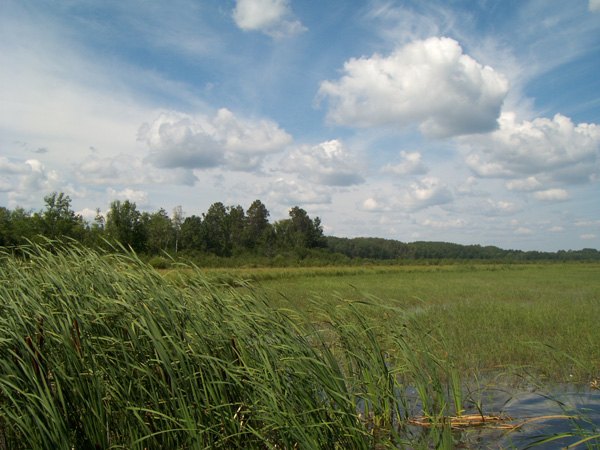
Water is abundant on the Chippewa, with over 1300 lakes, 925 miles of streams and 400,000 acres of wetlands. The forest’s landscape is a reminder of the glaciers which blanketed northern Minnesota some 10,000 years ago.

The forest is also one of the largest breeding population areas of bald eagles in the lower 48 states. Eagles are often viewed soaring over larger lakes of the area. White-tailed deer, ruffed grouse, and numerous waterfowl provide good wildlife viewing and hunting opportunities. Sensitive species such as the osprey, loon and great grey owl also make the Forest their home. The gray wolf and canada lynx are also present but rarely seen.

Water oriented recreation such as fishing, canoeing, camping, water-skiing, tubing and swimming are popular on the Chippewa. Twenty-three developed campgrounds, located on the major lakes, offer a place to relax or to fish muskie, walleye, northern pike, bass or sunfish. To “rough it” primitive campsites are available into more remote areas. Resorts are also located throughout the Forest. There are 298 miles of non-motorized trails to view the Chippewa National Forest and many miles of motorized recreation opportunities. Visitors have ample opportunities to hike and view spring wildflowers, bike along tranquil lakes, hunt grouse on a hunter walking trail or ski through the winter woods.

Over 150 people are employed by the Chippewa National Forest. Our jobs as specialists in archeology, wildlife, forestry, water, engineering and recreation enable us to manage the Forest for you. Together with computer support personnel we work as a team to carry our the Forest Service mission of “Caring for the land and serving people”.

Visit the Chippewa National Forest website.